6 Affordable AI SQL Tools for Startups
Table of Contents
- Introduction
- What Budget Database AI and Text to SQL Tools Can and Cannot Do
- Startup Database Tools Compared by Cost and Fit
- Choosing Affordable SQL and Database Query Tools for Each Job
- Build a Lean Startup Data Stack in Five Steps
- Security Rules for AI SQL Tools and Database Access
- Four Practical Startup Examples
- When Budget Database AI Needs a Paid Upgrade
- Conclusion
- Introduction
- What Budget Database AI and Text to SQL Tools Can and Cannot Do
- Startup Database Tools Compared by Cost and Fit
- Choosing Affordable SQL and Database Query Tools for Each Job
- Build a Lean Startup Data Stack in Five Steps
- Security Rules for AI SQL Tools and Database Access
- Four Practical Startup Examples
- When Budget Database AI Needs a Paid Upgrade
- Conclusion
Introduction
Startup database tools make data accessible before a company builds a full analytics team. A marketing manager can identify campaigns producing paying customers. A developer can investigate a slow query.
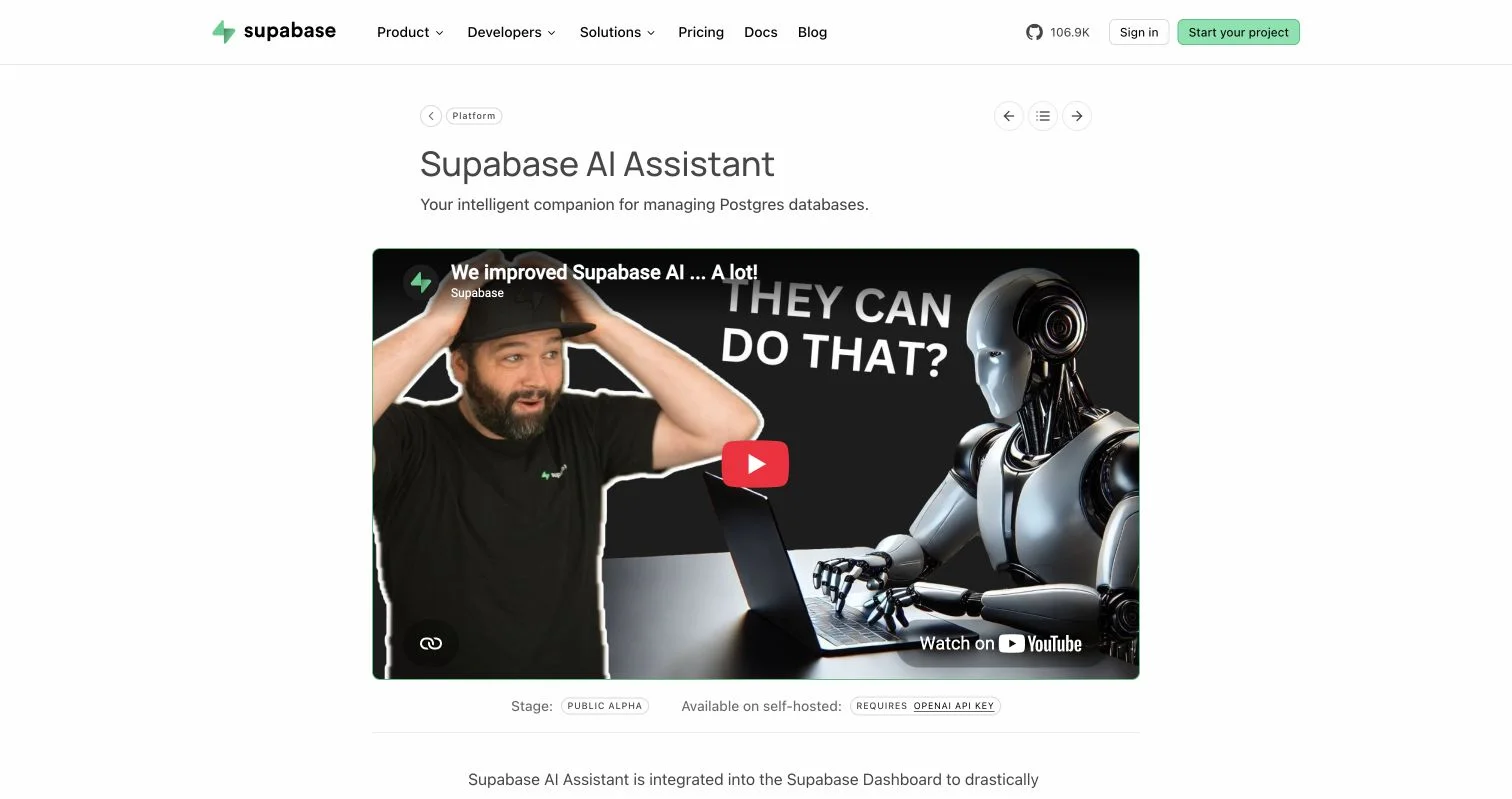
Supabase’s AI Assistant helps teams work with their database from the dashboard..
An operations lead can build a report without mastering SQL.
The challenge is choosing affordable SQL tools without security risks or costs that rise after a short trial. Free software may still require hosting, an AI model, maintenance, and engineering time.
TL;DR: Start with one secure, affordable tool, test known questions, and upgrade when usage or maintenance justifies it.
- Six budget-friendly AI database tools and current entry costs
- A simple startup data stack
- Safe setup for database beginners
- Signs to move to a paid plan
What Budget Database AI and Text to SQL Tools Can and Cannot Do
A database stores information in structured tables. A customer table might have one row per customer; an orders table, one per purchase. SQL filters, joins, summarizes, and updates those tables.
Budget database AI and other AI SQL tools add natural-language access. A user can request monthly recurring revenue by acquisition channel, and the tool drafts the SQL. Some explain queries, recommend indexes, or connect data across systems.
Teams can use these AI SQL tools for:
- Turning plain language into a first SQL draft
- Explaining joins, filters, and calculations to beginners
- Diagnosing slow PostgreSQL or MySQL queries
- Converting approved results into charts or summaries
- Reusing definitions such as active customer or qualified lead
They do not understand a company automatically. If one table records gross revenue and another revenue after refunds, an AI tool may choose the wrong field. It may invent a column, create an expensive join, or misread a date range.
Treat generated SQL as a draft: use read-only access, inspect it, and test on limited data. AI SQL tools speed answers, but the database remains the source of truth.
Startup Database Tools Compared by Cost and Fit
Vanna and Wren AI support custom data assistants. SQLAI.ai offers a hosted interface requiring almost no setup. Chat2DB is a local database client. Aiven optimizes queries, while MindsDB queries connected systems.
| Tool | Entry cost and license | Best fit | Limit to understand |
|---|---|---|---|
| Vanna | Free MIT open source; hosting and model usage are separate | Custom natural-language data assistants | The team must manage deployment, authentication, monitoring, and model choice |
| Wren AI | Free open-source engine and CLI; Apache 2.0 core | Consistent business definitions across 20+ sources | The current developer-oriented free core excludes the full commercial interface |
| SQLAI.ai | Hobby: $4 monthly for 50 queries; Starter: $6 for 200 | Individuals wanting a quick hosted SQL generator | Limited allowances; the optimizer or validator may consume two queries per use |
| Chat2DB Community | Free local community edition; bring-your-own-model option | Desktop SQL client with AI assistance for 30+ databases | Current releases use a source-available license with extra conditions and target single-user local use |
| Aiven SQL Query Optimizer | Free during Early Availability; no direct database connection required | Checking one PostgreSQL or MySQL query without platform installation | Users manually paste SQL and optional metadata; the standalone optimizer lacks masking |
| MindsDB Query Engine | Free self-hosting; current main repository uses MIT | Querying structured and unstructured information through one SQL-style layer | Broad integrations add deployment and permission work |
Prices and licenses change, so verify the current Vanna plans, Wren AI deployment options, and SQLAI.ai pricing before committing.
The current Chat2DB Community repository lists version 5.3.0 onward as source-available under restricted Apache-based terms; older releases remain Apache 2.0. Older comparisons may list MindsDB as MIT plus Elastic, but its current main repository license is MIT. Review the license for the exact release and component you deploy.
Choosing Affordable SQL and Database Query Tools for Each Job
Do not start with the longest feature list. Start with today’s repetitive task. That usually reveals a smaller, cheaper choice.
- For occasional SQL generation: SQLAI.ai requires the least setup. Its $4 Hobby tier is currently cheapest; the $6 Starter tier provides 200 monthly queries.
- For a local database workspace: Chat2DB Community combines a SQL editor, database browser, saved history, and a configurable AI assistant. Its Docker instructions recommend at least 2 CPU cores and 4 GiB of RAM.
- For a custom assistant inside a product: Vanna OSS is MIT-licensed and can run on your infrastructure. It suits teams with a developer to own the code and connect an approved model.
- For shared business definitions: Wren AI models entities, relationships, and calculations before an agent writes SQL. This helps when customer, order, and revenue have precise internal meanings.
- For one slow query: Aiven’s standalone optimizer is the lightest first step. Paste a PostgreSQL or MySQL statement with optional schema statistics, then review rewrite and index suggestions.
- For many live data sources: MindsDB supports Docker or Python and advertises connectors for more than 200 data sources.
Test one narrow workflow before adopting a general platform. A tool that reliably answers one weekly marketing question is more useful than a broad system nobody trusts.
Build a Lean Startup Data Stack in Five Steps
A startup data stack does not initially need a warehouse, transformation framework, dashboard platform, and AI layer. Start near the operational database and add components only to solve measured problems.
-
Choose one question. Identify a recurring decision, such as which channels produce customers active after 30 days. Define expected output, owner, and refresh frequency.
-
Create a safe data path. Make a read-only database user and, where possible, expose approved views rather than raw tables. Remove passwords, payment details, access tokens, and fields irrelevant to the analysis.
-
Document the meaning of the data. Record table purposes, join fields, time zones, and metric formulas. Specify whether revenue includes tax, refunds, and cancelled subscriptions. Vanna learns from documentation and approved queries; Wren puts these definitions in its modeling layer.
-
Run a small evaluation. Prepare 20 representative questions. Compare generated results with answers verified by a database expert. Track accuracy, bad joins, invented fields, response time, and cost per accepted answer.
-
Publish only approved outputs. Save reviewed SQL in version control or a shared query library. Give marketing and operations approved reports before offering unrestricted natural-language queries.
| Trial measure | Practical starting target | Why it matters |
|---|---|---|
| Result accuracy | At least 18 of 20 test questions | Fluent explanations are useless when numbers are wrong |
| Unreviewed write queries | 0 | AI must not change production data during trials |
| Response time | Under 30 seconds for routine questions | Slow answers discourage regular use |
| Monthly tool and model cost | Set a ceiling before testing | Open source can still create variable AI and hosting bills |
Security Rules for AI SQL Tools and Database Access
The greatest risk is giving an AI tool unnecessary access. A generated SELECT can expose private data, while UPDATE, DELETE, and schema changes can damage production records.
| Item | What to Check | Why It Matters |
|---|---|---|
| Database role | Use a read-only account limited to approved schemas | Limits damage from incorrect SQL or stolen credentials |
| Sensitive fields | Exclude or mask personal, financial, and authentication data | Prevents unnecessary data reaching users or model providers |
| Query limits | Enable timeouts, row limits, and cost controls | Stops bad joins consuming database capacity |
| Model policy | Know which schema details and results leave the network | A self-hosted interface does not guarantee a local AI model |
| Logging | Record prompts, generated SQL, execution identity, and failures | Makes errors traceable and supports review |
| Human approval | Writes and expensive production queries require review | Prevents unattended AI administration |
Use Aiven’s standalone optimizer carefully. It needs no database credentials, reducing one risk, but its documentation says the standalone version lacks masking. Replace customer values, emails, tokens, and confidential table names before pasting queries.
Local tools need normal security work. Chat2DB Community encrypts stored database passwords and model keys, but its single-user web mode has no authorization boundary. Bind it to localhost, not an office or public network.
Four Practical Startup Examples
These are representative trials, not vendor customer claims. Each has a specific question and measurable stop condition.
| Situation | Tool and approach | Trial metric | Upgrade trigger |
|---|---|---|---|
| SaaS marketer needs weekly trial-to-paid conversion by channel | Draft with SQLAI.ai against documented campaign, account, and subscription tables | Match the finance-approved report for four weeks | Users need shared data sources, higher quotas, or centrally managed query rules |
| Marketplace has several active-seller definitions | Model the approved definition in Wren AI with completed orders and a 30-day window | At least 90% of 20 test questions use the correct seller definition | Business users need the commercial interface, permissions, dashboards, and vendor support |
| Developer investigates a checkout query with 1.8-second p95 latency | Paste sanitized SQL, table structure, and statistics into Aiven’s optimizer | Reduce p95 below 500 milliseconds in staging without slower writes | Continuous workload monitoring replaces one-query reviews |
| Operations checks PostgreSQL orders and support issues elsewhere | Self-host MindsDB with restricted connections to approved sources | Produce weekly exception reports without CSV exports | Connection count, uptime, or audit obligations exceed team capacity |
Vanna is useful when answers must appear inside an existing product. A developer can build a small internal assistant, train it with approved SQL examples, and expose only a few safe tools. Start with ten trusted users and a daily question cap. If users return and reviewed accuracy stays above target, invest more engineering time.
When Budget Database AI Needs a Paid Upgrade
Free and low-cost startup database tools work well during discovery. They lose appeal when hidden maintenance costs exceed the subscription price. The issue is whether the current setup costs time, reliability, or control, not company growth.
| Signal | Stay free when | Consider paying when |
|---|---|---|
| Usage | A few people run occasional questions | Rate limits disrupt weekly work or concurrent queries |
| Operations | One developer can maintain the service | Failures divert engineers from product work |
| Security | Read-only access and simple logs are enough | The company needs SSO, role-based permissions, audit logs, or formal reviews |
| Reliability | The tool is experimental; downtime is acceptable | Reports affect customers, billing, or daily operations |
| Support | Community documentation resolves problems | The team needs response guarantees, onboarding, or an uptime agreement |
| Model cost | Low query volume keeps usage predictable | Repeated context, large schemas, or retries raise costs |
Open source makes sense when control and customization justify owning the infrastructure. Vanna’s free MIT framework and Wren’s Apache-licensed core are strong options for teams with engineering capacity. Paid hosting makes sense when authentication, monitoring, upgrades, and support become a second product to maintain.
Review total monthly cost, including compute, model calls, backups, staff time, and incident response. A $50 hosted plan may cost less than several engineering hours, though high usage and existing infrastructure can reverse the calculation.
Conclusion
The right tool is the smallest one that safely solves a recurring problem. SQLAI.ai offers a quick paid start; Aiven inspects a slow query without a database connection. Chat2DB provides a free local workspace, while Vanna, Wren AI, and MindsDB give technical teams greater control over a custom startup data stack.
Keep the first project narrow:
- Choose one business question
- Connect through read-only views
- Test 20 known examples
- Record accuracy, response time, and total cost
- Upgrade only when usage, security, or maintenance provides a measurable reason
This keeps startup database tools useful, not decorative. It gives marketing and IT teams more than impressive generated SQL: numbers they can understand, verify, and use.
Frequently Asked Questions
Can a non-technical user work with these tools?
Yes, but the database still needs documented tables and approved metrics. Natural language reduces SQL work; it cannot settle revenue or retention definitions.
Should AI connect directly to production?
Prefer a read replica, analytics database, or restricted views. If production access is unavoidable, use a read-only role, statement timeout, row limits, and logging.
Does self-hosted mean completely free?
No. Vanna, Wren AI, Chat2DB, and MindsDB may eliminate platform fees, but compute, storage, model requests, maintenance, and staff time remain.
Which affordable SQL tool is easiest for a first test?
SQLAI.ai is the simplest hosted query generator. Aiven is lighter for one PostgreSQL or MySQL query because it requires no database connection.
When should a startup add a warehouse?
Add one when reporting queries affect the application, teams need consistent cross-system history, or operational tables cannot support the analysis, not because a standard architecture diagram includes one.
How often should generated SQL be reviewed?
Review every new query during the trial. Later, automate reviewed templates but still check changed prompts, schema migrations, unusual results, and expensive statements.
Which AI SQL tool is best for a startup’s first trial?
Choose based on one immediate task rather than the broadest feature set. SQLAI.ai is convenient for quick hosted SQL generation, Aiven suits one-off query optimization, and Chat2DB provides a local workspace. Vanna, Wren AI, and MindsDB are better suited to teams prepared to manage infrastructure and integrations.
Is it safe to connect an AI SQL tool to a production database?
A read replica, analytics database, or set of restricted views is safer than unrestricted production access. Use a read-only account, exclude sensitive fields, and enforce query timeouts, row limits, and logging. Require human approval for writes and potentially expensive queries.
How can a startup check whether generated SQL is accurate?
Test the tool with about 20 representative questions whose answers have already been verified. Review joins, filters, date ranges, metric definitions, invented fields, response times, and costs. Treat every new query as a draft until it has been inspected and validated.
Can non-technical employees use natural-language database tools reliably?
They can use them effectively once tables, relationships, time zones, and business metrics are clearly documented. Natural language simplifies query creation but cannot decide what terms such as revenue, retention, or active customer mean for the company. Start users with approved reports and reviewed query templates.
Are open-source and self-hosted database AI tools actually free?
They may remove software subscription fees, but they still create costs for compute, storage, AI model usage, monitoring, upgrades, and engineering support. Compare the full monthly operating cost with a hosted plan. Paying can be cheaper when maintenance regularly consumes developer time.
When should a startup add a data warehouse?
Add one when analytics queries affect application performance, teams need consistent historical data from several systems, or operational tables cannot support reliable reporting. A warehouse is usually unnecessary for an initial narrow trial. Begin with restricted access near the operational database and expand when measured needs justify it.
What signals indicate it is time to upgrade to a paid plan?
Consider upgrading when query limits interrupt work, maintenance distracts engineers, or important reports require stronger reliability. Paid features also become valuable when the company needs SSO, role-based permissions, detailed audit logs, formal support, or uptime guarantees. Base the decision on total cost and operational risk rather than company size alone.
Related Articles
Why Text-to-SQL Fails and How to Fix It
Learn how to prevent NL2SQL errors caused by schema ambiguity, complex joins, dates, NULLs, and security gaps in AI-generated SQL.
Freelance SQL Tools: Affordable AI Setup Guide
Compare affordable SQL tools, licenses, AI workflows, pricing, and safety checks for accurate, private freelance database work.
Best AI Tools for SQL Beginners
Compare beginner-friendly AI SQL tools, learn safe text-to-SQL workflows, and verify generated queries with practical examples and tips.