Enterprise SQL Tools: AI Governance, RBAC & Audits
Table of Contents
- Introduction: Enterprise SQL tools need boundaries
- How enterprise text to SQL works in an enterprise AI database
- Comparing enterprise SQL tools: Seek AI, ThoughtSpot, and Querio
- AI SQL governance requirements to settle before procurement
- Database RBAC implementation for team SQL tools
- SQL audit trails that make governance SQL provable
- A six-step rollout for enterprise SQL tools
- Real-world enterprise AI database applications in regulated and large teams
- Common AI SQL governance mistakes to avoid
- Conclusion: Choose control before convenience
- Introduction: Enterprise SQL tools need boundaries
- How enterprise text to SQL works in an enterprise AI database
- Comparing enterprise SQL tools: Seek AI, ThoughtSpot, and Querio
- AI SQL governance requirements to settle before procurement
- Database RBAC implementation for team SQL tools
- SQL audit trails that make governance SQL provable
- A six-step rollout for enterprise SQL tools
- Real-world enterprise AI database applications in regulated and large teams
- Common AI SQL governance mistakes to avoid
- Conclusion: Choose control before convenience
Introduction: Enterprise SQL tools need boundaries
Enterprise SQL tools let a marketing manager ask, “Which campaigns produced qualified pipeline last quarter?” and get an answer without SQL. That is useful.
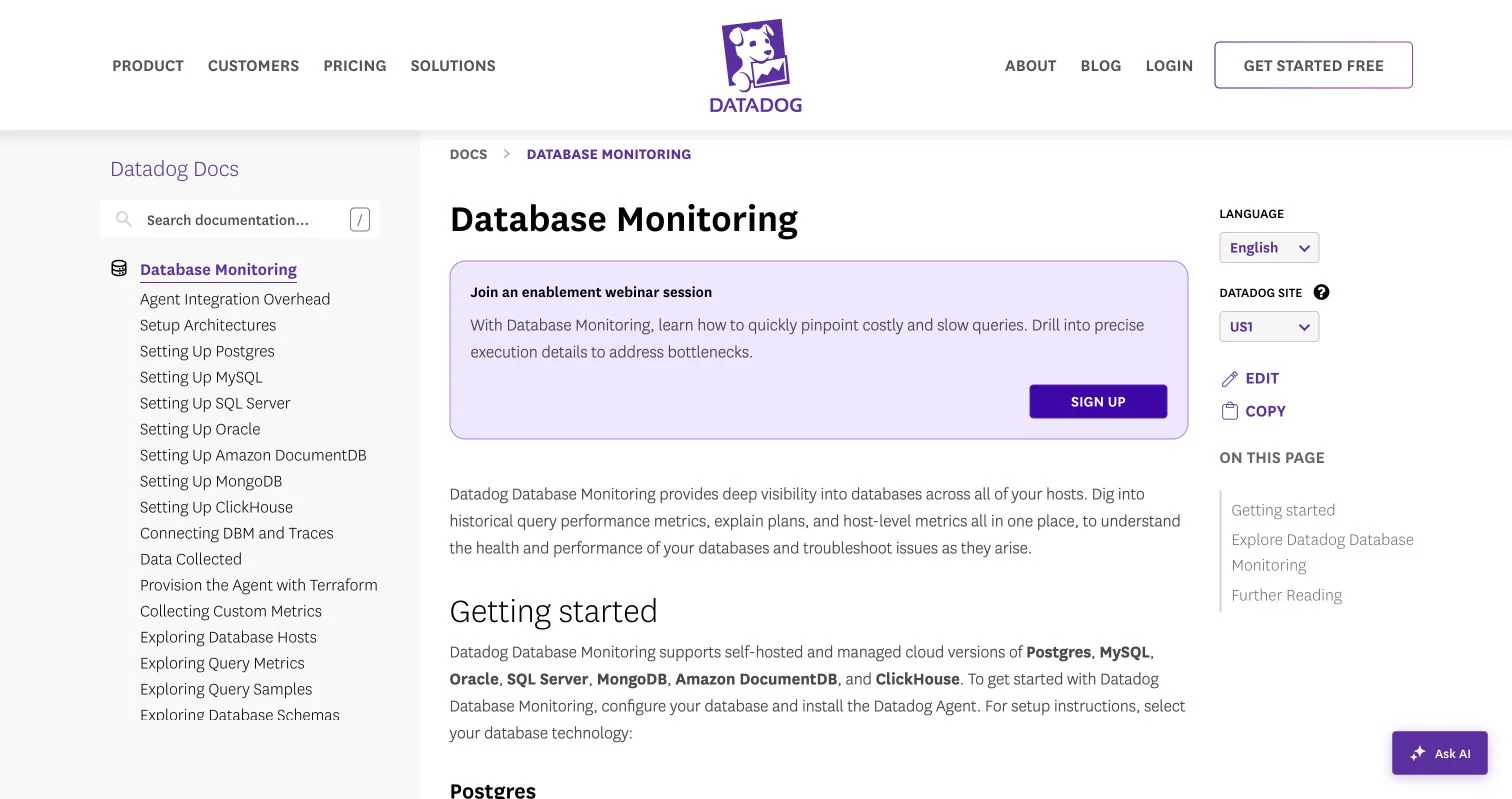
Datadog’s database monitoring product illustrates the observability layer common in enterprise SQL stacks..
It also creates a route into sensitive databases. An enterprise AI database must translate ordinary language into sound queries and enforce the same controls as for trained analysts.
TL;DR: Enterprise SQL tools need accurate answers, database RBAC, and SQL audit trails; the permission model is the product.
This guide covers:
- How AI SQL works from question to database result.
- How Seek AI, ThoughtSpot, and Querio differ in price and enterprise controls.
- How to set up governance SQL, role-based access control, audit trails, and a measured rollout.
give more people useful data access without giving everyone or every AI agent a live database key.
How enterprise text to SQL works in an enterprise AI database
A database stores information in tables. Tables have rows, such as orders, and columns, such as order date, customer region, and revenue. SQL filters, joins, counts, and summarizes those records. An enterprise AI database adds a natural-language layer, while the database performs the calculation.
A well-designed request follows:
- The user asks a business question. “How many trial accounts became paying customers within 30 days?” is clearer than asking for “conversion.”
- A semantic layer defines the terms. It identifies the “paying” field, the date starting the 30-day window, and how to exclude test accounts.
- The model drafts SQL. Good team SQL tools show the query or explain its logic.
- The warehouse checks permissions. The query should use the user’s role, row filters, and column restrictions, not an all-powerful shared account.
- The system returns and records the result. The audit trail captures the answer, source tables, query, user identity, and policy decisions.
AI can produce valid SQL for the wrong question. So business definitions and permissions matter as much as model quality.
Comparing enterprise SQL tools: Seek AI, ThoughtSpot, and Querio
These enterprise SQL tools serve different buyers.
Seek AI focused on enterprise natural-language data agents. In June 2025, IBM said it would acquire Seek AI expertise and license its technology; other reports called it an acquisition. Seek announced a clean SOC 2 Type II attestation in 2023 after Johanson Group LLP’s examination (Seek AI).
| Tool | Strong fit | Governance and team features | Price signal | Buying caution |
|---|---|---|---|---|
| Seek AI / IBM | Enterprises building natural-language data agents with IBM | SOC 2 Type II attestation; enterprise data-agent focus | Quote-based | Confirm the product, support path, and IBM relationship after the 2025 transaction. |
| ThoughtSpot Enterprise | Large, governed self-service analytics deployments | SSO, RBAC, row-, column-, and object-level security, lineage, and audit logs | Enterprise pricing is custom; independent contract data puts many deployments at $100,000 to $500,000 annually. | Model total cost using users, query or credit consumption, data scale, setup, and support. |
| Querio | Many viewers, with few asking questions | Unlimited-viewer model, natural-language querying, and advertised access controls | A 2025 offer: $14,000 annually for one database, 4,000 monthly prompts, and unlimited viewers. | Reconfirm the quote, add-ons, security evidence, and terms as pages change. |
ThoughtSpot’s current pricing page lists custom Enterprise pricing; SpendHound reports a $327,115 average across 160 customers (SpendHound). Querio listed add-ons of $6,000 for dashboards, $4,000 per extra database, and $10,000 for up to three pipelines (Querio). Those figures guide planning but do not replace a written quote.
AI SQL governance requirements to settle before procurement
Governance SQL defines who may ask what, which data may respond, and how to reconstruct events. Certification helps procurement but does not configure roles, retention, or metrics. SOC 2 Type II examines whether specified controls operated over time; it does not guarantee every deployment is governed.
Use this checklist before a pilot:
| Control area | What to require | Why it matters |
|---|---|---|
| Identity | SSO, MFA, group sync or SCIM, and fast deprovisioning | Promptly revoke former staff and unmanaged accounts. |
| Authorization | Database-enforced RBAC and row- and column-level rules where possible | Prompt changes must not expose another region’s data. |
| Data use | Written rules for prompts, result storage, model training, subprocessors, residency, and deletion | Even with data in the warehouse, the AI layer may handle sensitive metadata. |
| Query safety | Read-only credentials, timeouts, row limits, blocked schemas, and cost limits | Read-only queries can leak data or incur high compute costs. |
| Meaning | Approved metrics, joins, synonyms, owners, and change history | “Customer” and “revenue” need reviewed definitions. |
| Evidence | Exportable, tamper-resistant logs with user, SQL, objects, policy result, and timestamp | Security and compliance teams need a defensible record. |
| Operations | Owners for access review, incident response, model changes, and vendor review | Controls decay when nobody owns them. |
This approach matches the continuous governance idea in the NIST AI Risk Management Framework, which organizes work around govern, map, measure, and manage.
Database RBAC implementation for team SQL tools
Database RBAC (role-based access control) assigns permissions to roles and people to roles. NIST defines RBAC through users, roles, permissions, operations, and protected objects (NIST). Start team SQL tools with a reviewable role model.
| Role | Typical ability | Restriction |
|---|---|---|
| Viewer | Open approved answers and dashboards | Cannot query raw tables or export detailed records. |
| Explorer | Query approved models | Cannot see restricted columns or publish official metrics. |
| Analyst | View generated SQL, build models, and save analyses | Production writes and security changes remain blocked. |
| Data steward | Approve definitions, joins, and certified datasets | Cannot grant themselves platform administration. |
| Administrator | Manage users, integrations, and policies | Business-data access remains separate and need-based. |
Implement the model in this order:
- Map job tasks to datasets. Do not copy untidy folder structures into the product.
- Create warehouse roles and views first. The AI tool should inherit them rather than duplicate security.
- Apply territory or account-ownership row filters and mask email, health details, and payment identifiers.
- Separate administration, metric approval, and data use. No one should silently change a definition and certify the resulting report.
- Test denied requests. Test sales-user requests for other regions’ customers, hidden columns, and raw exports. Secure refusals pass.
Review group membership after job changes and quarterly. Review privileged roles monthly.
SQL audit trails that make governance SQL provable
An audit trail should show who asked what, against which data and policy, and what followed. ThoughtSpot says its governance layer provides calculation-, table-, column-, and query-level visibility with complete audit logs (ThoughtSpot).
Capture context needed to reproduce an event:
| Log field | Practical purpose |
|---|---|
| Identity and session | Links actions to a person, service account, role, device, and sign-in method. |
| Prompt and generated SQL | Shows user intent and the executed query. |
| Sources and policy decision | Records tables, columns, row rules, denials, and approvals. |
| Model and semantic version | Explains later answer changes from the same wording. |
| Action and result metadata | Records execution, errors, row counts, exports, shares, and dashboard publication without duplicating sensitive results across logs. |
| Time and trace ID | Connects AI events with warehouse, identity-provider, and security logs. |
Send SQL audit trails to central security, restrict access, synchronize clocks, and alert on unusual exports, repeated denials, and query-volume spikes. Do not store full query results in logs; the audit system can become another sensitive database.
Retention is a policy decision. Healthcare teams should note that the HIPAA Security Rule requires mechanisms to record and examine activity in systems containing electronic protected health information (HHS). Match retention to law, contracts, incident needs, and data-minimization rules.
A six-step rollout for enterprise SQL tools
Start with one recurring decision. A 30- to 45-day pilot with 20 to 50 users is usually easier to assess than a company-wide launch. These are practical starting points, not industry rules.
- Choose one bounded use case. Marketing campaign performance, support volume, or sales pipeline works better than “all company data.”
- Create an approved question set. Collect 25 to 50 real questions, expected answers, permitted sources, and known edge cases. Include required refusals.
- Prepare the data. Name fields clearly, define metrics, remove obsolete columns, and create restricted views. AI cannot fix unclear source data.
- Run parallel validation. Compare generated SQL and results with trusted reports. Classify failures as permission, definition, join, freshness, or calculation errors.
- Set launch thresholds. An internal target might require 100% access-control-test success, at least 95% approved-question agreement, and named review of high-impact answers. Base thresholds on risk, not vendor demos.
- Expand by role and dataset. Expand only after logs, support, access reviews, and incident procedures work. Re-test after model, semantic-layer, connector, or warehouse-policy changes.
Track answer agreement, refusal accuracy, median response time, warehouse cost per accepted answer, weekly active users, and analyst time saved. Expand access based on measured performance.
Real-world enterprise AI database applications in regulated and large teams
The same tool can be safe in one workflow and reckless in another. Context decides.
| Example | Safe design | Business result |
|---|---|---|
| Regional bank | A branch manager asks about delinquency by product. Row security limits results to the branch, masks account numbers, and requires human approval for regulatory reports. | Faster investigation without making conversational SQL an unsupervised reporting authority. |
| Healthcare marketing | A marketer studies service demand using aggregated, de-identified data. The system suppresses small groups, blocks patient-level exports, and logs every access. | Improves campaign planning without exposing electronic health information. |
| Retail marketing | The team certifies definitions for attributed revenue, returns, and campaign cost. The AI role cannot access customer emails or addresses. | People can compare campaigns while finance and marketing use the same math. |
| B2B software company | Twenty-five creators serve 800 viewers. The company compares Querio’s published $14,000 unlimited-viewer base with per-seat and consumption offers, including add-ons and warehouse spend. | The cost model reflects actual analytics use instead of treating every reader as an analyst. |
| Financial technology company | A governed analytics platform combines natural-language questions with row-level security and monitored conversations. | ThoughtSpot reports that FrankieOne shifted 232 hours per week from chasing answers and achieved a six-figure annual cost reduction (ThoughtSpot). Treat this as vendor-reported and validate comparable savings in your pilot. |
These examples show why enterprise SQL tools need both a useful interface and controls close to the data.
Common AI SQL governance mistakes to avoid
The costliest mistakes can look harmless in a polished proof of concept.
- Using one shared database owner account. Everyone inherits the same access, and warehouse logs cannot reliably identify each querier.
- Assuming read-only means low risk. SELECT can expose every customer row, infer sensitive facts, or scan costly tables.
- Testing syntax but not meaning. Correct SQL can use the wrong date, join, currency, or revenue definition.
- Keeping permissions only in the AI app. Warehouse rules add a boundary if the application is misconfigured or bypassed.
- Logging too little or too much. Missing SQL or identity blocks investigations; logging every result creates another sensitive-data store.
- Launching before ownership exists. Someone must approve metrics, review access, support users, and handle incidents.
- Treating a certification badge as the control system. Ask for the report scope, exceptions, subprocessor list, penetration-test summary, and evidence that required features exist in the purchased tier.
The risk is measurable. IBM’s 2025 study found that 97% of organizations reporting an AI-related security incident lacked proper AI access controls, while 63% lacked AI governance policies (IBM). Governance SQL belongs in the first design session, not post-launch cleanup.
Conclusion: Choose control before convenience
The right enterprise AI database product eases ordinary questions without weakening company-data controls.
Seek AI offers data-agent experience, SOC 2 Type II evidence, and a new IBM relationship. ThoughtSpot offers broad enterprise governance and scale with typical six-figure pricing. Querio’s unlimited-viewer model may lower costs for large read-heavy deployments, but procurement must review current terms and security evidence.
Before buying, prove:
- Permissions withstand forbidden questions.
- Business terms produce consistent SQL and results.
- Audit trails reconstruct important actions.
- Cost remains predictable as viewers, prompts, and data grow.
Pick a narrow workflow, test real questions, measure errors and savings, then expand. Good team SQL tools do not replace data teams. They help data teams turn access, meaning, and governance into a company-wide system.
Frequently Asked Questions
Should an enterprise SQL tool connect with a shared database account?
No. The tool should query through each user’s role so the warehouse can enforce existing row, column, and dataset restrictions. Shared privileged accounts weaken access controls and make individual activity harder to trace.
Does read-only database access make AI-generated SQL safe?
Not by itself. Read-only queries can still reveal sensitive records, infer protected information, or create excessive warehouse costs. Use restricted views, row limits, query timeouts, blocked schemas, masking, and cost controls.
What should a company test during an enterprise SQL tool pilot?
Test real business questions, expected answers, edge cases, and requests the system must refuse. Compare generated SQL with trusted reports and classify errors involving permissions, definitions, joins, freshness, and calculations. Access-control tests should pass before the pilot expands.
Which information should an SQL audit trail capture?
Record the user and role, prompt, generated SQL, accessed objects, policy decision, semantic and model versions, timestamp, and resulting actions such as exports or shares. Send these records to a protected central logging system. Avoid copying full query results into logs unless a specific requirement justifies the additional exposure.
How should business terms such as “revenue” or “customer” be governed?
Define approved metrics, joins, exclusions, synonyms, owners, and change history in a reviewed semantic layer. Separate the ability to change a definition from the authority to certify it. Re-test important questions whenever definitions, models, connectors, or warehouse policies change.
How should Seek AI, ThoughtSpot, and Querio be compared?
Evaluate them against the intended workflow, security controls, deployment model, viewer-to-creator ratio, prompt volume, data scale, and support needs. ThoughtSpot targets broad governed analytics, Querio may suit deployments with many viewers and fewer question askers, and Seek AI’s offering should be clarified in light of its IBM relationship. Obtain current written quotes and confirm which governance features are included.
How often should database roles and permissions be reviewed?
Review access after job changes and deprovision departing users promptly. A practical baseline is quarterly review of regular group membership and monthly review of privileged roles. Higher-risk or regulated environments may require more frequent checks.